The Gospel of Mary
Titled at its end: The Good News According to Mary
In no church’s Bible. No ancient writer is known to mention it, and it was unknown until a copy came to light in 1896.
Which Mary? Mary Magdalene, most scholars agree, not Mary the mother of Jesus. The text itself calls her only “Mary”.
About it
The Gospel of Mary is an early Christian writing in which the risen Savior answers his disciples’ questions and leaves them, and Mary, most likely Mary Magdalene, comforts them and tells them what he showed her in a vision: how the soul rises past the powers that try to hold it. Andrew doubts that the Savior said such things, and Peter that he would teach a woman what he kept from them; Levi defends her, and they go out to preach. Jesus is never named: he is “the Savior”, “the Blessed One” and “the Lord”.
Which Mary? The text never says, but most scholars take her to be Mary Magdalene, the first to see the risen Jesus in the Gospels (John 20:11–18), and not his mother. Levi says here that the Savior loved her more than the disciples, as the Gospel of Philip, another early writing, says of Mary Magdalene; Peter resents her here as he resents Mary Magdalene in the Pistis Sophia; and the form of her name, Mariham in the Coptic and Mariamme in the Greek, is one often used for the Magdalene. A few scholars argue for Jesus’ mother, or for a figure drawn from both.
It was written in Greek, most scholars think in the second century: two Greek fragments copied in the early third century show it was being copied in Egypt by then. Its teaching on matter, the soul and the powers has much in common with the Gnostic writings of that time, though scholars differ on how far it is one of them.
More than half of it is lost. The fullest copy is a Coptic translation, the first of four works in a small papyrus book copied in the fifth century and now in Berlin (Papyrus Berolinensis 8502, the Berlin Codex). It was offered for sale in Cairo in January 1896 and bought for the Berlin museum, its pages 1 to 6 and 11 to 14 already missing. Publishing it took sixty years: in 1912 a burst water pipe at the printer’s in Leipzig destroyed the first edition, and two world wars and the discovery of the Nag Hammadi library held up the next, until Walter Till published it in 1955.
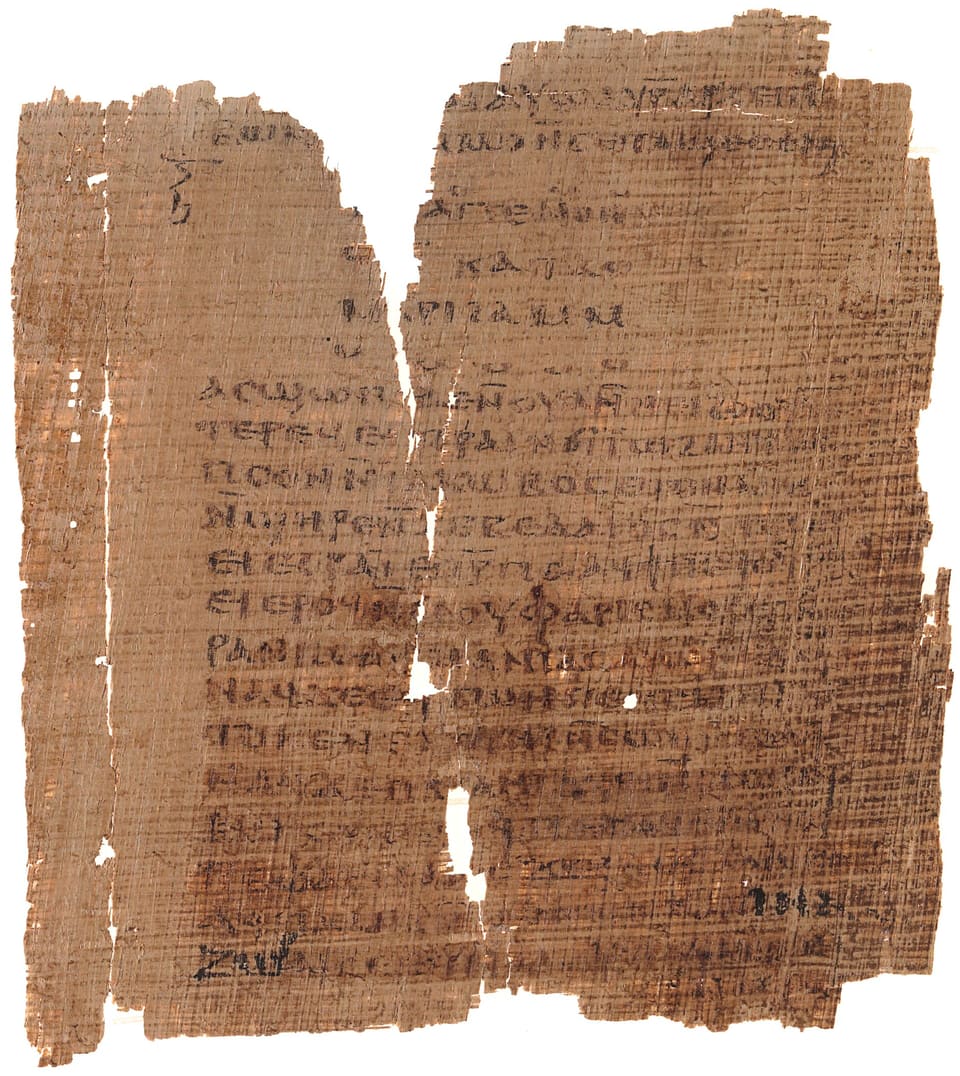
The text
- The numbers are the Berlin Codex’s page and line where each sentence begins (7,1 is page 7, line 1), the way scholars cite it.
- […] marks words lost from the papyrus. Words in square brackets are restored where it is damaged; the notes say why.
- Mary is still telling what she was shown on pages 15 to 17, but pages 11 to 14 are lost, so whether those are the Savior’s words to her or her own telling is unknown. The speeches inside her account are in single quotation marks, and her account ends just before 17,7.
- The soul is “it” here; the Coptic says “she”, as its word for soul is feminine.
Pages 1–6
Pages 1 to 6 are lost. The text begins in the middle of a question.
Page 7
7,1[…] matter, then: will it be destroyed or not?”
7,2The Savior said, “All natures, all formed things, all creatures exist in and with each other, and they will be dissolved back into their own root.
7,6Matter’s nature dissolves into what belongs to its own nature, and to nothing else.
7,8Whoever has ears to hear should hear.”
7,10Peter said to him, “As you have explained everything to us, tell us this as well: what is the sin of the world?”
7,13The Savior said, “Sin does not exist. You are the ones who make sin, when you do things that resemble the nature of adultery, which is called ‘sin.’
7,17This is why the Good came among you, to what belongs to each nature, to restore it to its root.”
7,20He went on, “This is why you fall ill and die: because [you love] what [deceives you].1
Page 8
8,1Whoever understands should understand.
8,2Matter brought forth a passion with no likeness, because it came from what goes against nature.
8,4Then the whole body is thrown into turmoil.
8,6That is why I told you, ‘Be content in heart, and if you are not, be content before the many likenesses of nature.’
8,10Whoever has ears to hear should hear.”
8,11When the Blessed One had said this, he embraced them all, saying, “Peace be with you. Make my peace your own.
8,15Watch out that no one misleads you by saying, ‘Look, this way!’ or ‘Look, it’s here!’
8,18For the Son of Man is inside you. Follow him! Those who look for him will find him.
8,21So go and preach the Good News of the Kingdom.
8,22Do not set any rule beyond what I have laid down for you, and do not make laws as the lawgiver did, or you will be held captive by them.”2
Page 9
9,5When he had said this, he left. But they were grieving, and they wept hard. “How are we to go to the nations and preach the Good News of the Kingdom of the Son of Man?” they said.
9,10“If they did not spare him, why would they spare us?”
9,12Then Mary stood up, embraced them all, and said to her brothers, “Don’t weep. Don’t grieve or be of two minds, because his grace will be with you fully,3 and it will protect you.
9,18Instead, let us praise his greatness, because he has prepared us and made us into human beings.”
9,20When Mary said this, she turned their hearts toward the Good, and they began to talk over the [Savior’s]4 words.
Page 10
10,1Peter said to Mary, “Sister, we know the Savior loved you more than any other woman.
10,4Tell us whatever words of the Savior you remember, the ones you know and we don’t, and haven’t heard.”
10,7Mary answered, “I will tell you what is hidden from you.”
10,9And she began to tell them these things. “I myself,” she said, “saw the Lord in a vision, and I told him, ‘Lord, I saw you in a vision today.’
10,13He answered me, ‘Blessed are you, since the sight of me does not shake you. For the treasure is where the mind is.’
10,16I said to him, ‘So, Lord: when someone sees a vision, do they see it with the soul, or with the spirit?’5
10,19The Savior answered, ‘One sees neither with the soul nor with the spirit. The mind, which is between the two, is [the one that]6 sees the vision, and it is […]
Pages 11–14
Pages 11 to 14 are lost.7
Page 15
15,1[…] it. Then Desire said, ‘I did not see you on your way down, but now I see you on your way up. How can you lie, when you belong to me?’
15,5The soul replied, ‘I saw you, but you did not see me or recognize me. To you I was a garment, and you did not know me.’
15,9Having said this, it went on its way in great joy.
15,10Again it came to the third of the powers, the one called Ignorance. [It]8 questioned the soul: ‘Where are you going? You were held captive in wickedness. Yes, you were held captive. Do not judge!’
15,16The soul said, ‘Why are you judging me, when I have not judged? I was held captive, though I held no one captive. They did not know me, but I knew them: the All is being dissolved, earthly things and heavenly alike.’
Page 16
16,1When the soul had brought the third power to nothing, it went on up and saw the fourth power. It had seven forms.
16,5Its first form is darkness; its second, desire; the third, ignorance; the fourth, death’s jealousy; the fifth, the kingdom of the flesh; the sixth, the flesh’s foolish wisdom; the seventh, the wisdom of the hot-tempered.
16,12These are the seven powers of wrath.9
16,13They asked the soul, ‘Where are you coming from, killer of people? Where are you going, you who bring places to nothing?’
16,16The soul answered, ‘What held me captive has been slain, and what surrounded me has been brought to nothing. My desire is at an end, and ignorance is dead.
16,21In a world I was set free from a world, and in a pattern, from a pattern above, and from the chain of forgetfulness, which lasts for a time.
Page 17
17,4From this hour, in silence, I will receive the repose of the time, of the season, of the age.’”
17,7When Mary had said this, she said no more, since this was where the Savior had stopped speaking with her.
17,10But Andrew answered the brothers, “Tell us what you think of what she has said. I, for one, do not believe the Savior said this. These teachings are surely different ideas.”
17,15Peter answered, speaking about the same matters. He asked them about the Savior: “Did he really talk with a woman behind our backs, and not openly? Are we supposed to turn around and all listen to her? Did he prefer her to us?”
Page 18
18,1Mary wept. “Peter, my brother,” she said to him, “what are you thinking? Do you think I made this up myself, in my own heart, or that I am telling lies about the Savior?”
18,5Levi said to Peter in reply, “Peter, you have always had a hot temper.10 Now I see you arguing against the woman as the adversaries do.
18,10If the Savior made her worthy, who are you to cast her aside? The Savior certainly knows her through and through. That is why he loved her more than us.
18,15Instead, let us feel shame, clothe ourselves with the perfect human being and make him our own,11 as he commanded us, and preach the Good News, setting no other rule or law beyond what the Savior said.”
18,21When [Levi had said]12 this, they started out [to] tell and preach.13
Page 19
19,3The Good News According to Mary14
The Secret Book of John begins on the same page.
Notes
- 17,22–8,1 Of “you love what deceives you” only “what” and a few letters of “you” and “deceives” survive. The rest is the restoration of the editors Till and Schenke, which fits the space; “love” is a guess.
- 28,22–9,4 So one edition reads. Till and Schenke read one letter differently, making these the Savior’s words about himself: “I have not set any rule beyond what I laid down for you, nor have I made laws as the lawgiver did, so that you would not be held captive by them.” Levi repeats them as a command (18,18–21), and so does the Greek fragment.
- 39,17 Or, reading one letter differently, “will be with all of you” (Till and Schenke). The Greek fragment of these pages has neither: “with you, sheltering you.”
- 49,24 The word is lost but for the stroke the scribe wrote over shortened holy names. The Savior’s words come up again at 10,4.
- 510,18 The scribe wrote “or” and “with” in each other’s places; the Savior’s answer shows what is meant.
- 610,22 Restored from the same words in the next line.
- 711–14 When the text resumes, the soul is rising past the powers that try to hold it. The first power, and the soul’s meeting with it, were on the lost pages; Desire is the second.
- 815,12 Two letters are lost; only “it”, the power, fits what remains.
- 1018,7 “Hot temper”: the same word as in the seventh form of wrath, “the wisdom of the hot-tempered” (16,11–12).
- 1118,17 The line is badly faded. Till and Schenke read “and go out”. The reading here echoes the Savior’s “Make my peace your own” (8,14–15).
- 1219,1 About eight letters are lost. Levi is the last to speak, and the Greek fragment has “Having said this, Levi went off …”
- 1319,2 Only the end of “tell” survives.
- 1419,3–5 The title is written at the end, set apart, as books of the time often were. “Good News” is the word usually translated “gospel”; the World English Bible titles its Gospels “The Good News According to …”.
The Greek fragment (P.Ryl. 463)
A leaf of a small papyrus book copied in the early third century, two hundred years before the Berlin Codex, probably at Oxyrhynchus in Egypt, and now in the John Rylands Library, Manchester. Its two pages, numbered 21 and 22, hold the end of the gospel (Berlin Codex 17,4 to 19,5), with six to eight lines lost between them.
It is in the gospel’s own language, but it is not the copy the Coptic was translated from: their wording differs throughout, and here Levi alone goes out to preach. Its spelling of Mary’s name is Mariamme. The numbers are the papyrus’s lines; brackets and […] mean what they do above.
Page 21
1[…] from now on, in the course of the season, of the time, of the age, rest in silence.”
2Having said this, Mary fell silent, since the Savior had said only this much.
5Andrew said, “Brothers, what do you make of what has been said? I, for one, do not believe your Savior said these things,a for it seemed out of keeping with his way of thinking.
11Did the Savior, questioned about such things, speak to a woman in secret and [not]b openly, so that we would all hear? […] more worthy of note […]
Between the pages
Six to eight lines are lost.
Page 22
18[…] of the Savior.” Levi said to Peter, “Peter, your temper is always close at hand, and now you are quarrelling with the woman like this, as if you were her adversary.
22If the Savior thought her worthy, who are you to look down on her? He certainly knew her, and loved her steadfastly.
25Instead, let us be ashamed. Let us put on the perfect human being and do what we were commanded: preach the Good News, setting no rule and making no law, as the Savior said.”
31Having said this, Levi went off and began to preach [the Good News according to Mary].c
Notes on the Greek
- a8 So the edition reads, but only two letters of “your” survive, and “the” may be meant.
- b13 The papyrus has “and openly”; the editor adds “not”, as the Coptic has it.
- c32–33 Only a few letters survive. Whether the last words were the title, as in the Coptic, is not known.
Greek text: C. H. Roberts (1938), as encoded by the Digital Corpus of Literary Papyri (papyri.info), CC BY 3.0; translated here.
Other fragments
A second Greek fragment, P.Oxy. 3525, from a roll copied in the third century and found at Oxyrhynchus, overlaps pages 9 and 10, from the Savior’s leaving to the start of Mary’s vision. It is badly damaged and its edition is not openly licensed, so it is not translated here. Where its letters can be read it is close to the Coptic, with small differences: Mary kisses the disciples as well as greeting them; she says the Savior “joined us together” rather than “prepared us”, and turns their mind rather than their hearts; Peter says the Savior loved her “as no other woman”; and Mary offers to tell what escapes them and she remembers.
In 2024 some scholars proposed that a fourth-century fragment, P.Oxy. 5577, in which Jesus speaks to a Mary, comes from the lost pages. It is not settled, and it is not included here.
The translation
Translated for this site from the Coptic of the Berlin Codex, pages 7 to 10 and 15 to 19, and, below it, from the Greek of the fragment that holds its ending. The editors made it with AI, the way the rest of the site is made: three translations were made independently from a transcription of the Coptic checked letter by letter against the edition of Walter Till and Hans-Martin Schenke (1972), then compared line by line and reconciled into this one in plain modern English. Its sense was checked against published translations, and its wording compared with theirs so that it is its own.
It has not yet been reviewed by a scholar of Coptic. If you know the language and see something wrong, Send feedback, at the foot of every page, reaches the editors.
The translation and its notes are dedicated to the public domain: anyone may copy, change and use them, for any purpose, without asking. The Greek text the fragment is translated from is the Digital Corpus of Literary Papyri’s (CC BY 3.0), and the photograph is the Berlin museum’s (CC BY-SA 4.0), each under its own licence. CC0 1.0